Eat Mesquite!
Finding harmony and a potential path to Zion among the "weeds."

Welcome aboard Worthless Thoughts!
We got started on this writing project before we were really started, so we are amazed and encouraged at everyone who took a chance on this no-name Substack and subscribed. Thank you! We can’t guarantee that you’ll like what you read here, but you’ve been forewarned: it’s called Worthless Thoughts, after all.
This Substack will most certainly be a jumble of topics, but they will have an interlocking thread: how everything is pulled apart, and how we can put at least a few of the pieces back together. While we certainly won’t shy away from tackling egregiously bad or dishonest mindsets or philosophies, our goal is not merely to tear down but to build.
Perhaps this can be illustrated by a story drawn from our Utah Mormon pioneer heritage. In the early days of Mormon settlement, President Brigham Young sent out little bands of Saints throughout the Great Basin, not only to colonize the territory, but to work out the day-to-day living of the United Order, wherein all members of the community would live, work, and worship with all things in common, much like the early Christians of the New Testament. Local leaders were given leeway to organize their United Orders to fit local circumstances, and although many creative ideas were implemented, for various reasons—among them persecution of polygamist families by the federal government and the coming of the railroad—gradually even the most robust of these orders withered away.
Some Saints, though, were unwilling to admit defeat. They approached Brigham Young and asked for permission to start again in a new place southwest of Saint George, Utah. With President Young’s blessing, this small band of family and friends set out for what was then known as Mesquite Flats (in present-day Nevada). They named their little community Bunkerville and promptly set about making this remote stretch of desert their new home, building dams and digging irrigation canals, constructing homes, and leveling the land for cultivation.
One monumental task these pioneers undertook was that of grubbing out the mesquite trees growing prolifically in the aptly-named area. While the mesquite tree might not be a towering giant above ground, below the surface, its roots grow to astonishing depths. Mesquite roots have been found almost 200 feet below ground,1 a fantastic strategy for finding water in an arid climate, but a farmer’s nightmare. Add in the fact that mesquite trees also bristle with huge thorns and resprout from the roots if chopped down, and you can start to imagine what a formidable task these pioneers, armed with nothing more than hand tools and draft power, faced in transforming the area into productive farmland.
Bunkerville is situated in an area prone to violent, hot winds that damaged the pioneers’ half-constructed buildings, warped young trees, and coated everything—living and nonliving—in a thick layer of dust. When rain comes to this part of the world, it often comes all at once. With hardly any organic matter in the soil to soak in the water and slow it down, the rain rushes down the hills, concentrating in gullies, growing in volume and strength until it bursts into the river. The laboriously built dams of the pioneers were no match for the raw power of the desert flashflood.
That these stalwart Saints managed to wrest a living from such unfriendly land is a testament to their grit and unwavering devotion to the highest ideals. In 1877, their first year, the dozen or so families comprising Bunkerville reported the following harvest: 400 bushels of wheat, 700 gallons of molasses, 9,000 pounds of cotton, and lots of garden vegetables. By their second year, they had a molasses mill, flour mill, and cotton gin in operation. Things were off to a great start. But by 1881, the United Order in Bunkerville was no more. Records are demure as to the cause of its demise, but whatever the reasons, the Bunkerville Saints reluctantly divided their land into individual plots, to make their living independently.2 They had done their best.
But you have to wonder how much better it could have all turned out if only these talented, hard-working pioneers had understood the natural advantages of the terrain they were living in, and if instead of seeking to force the land to behave according to their wishes, they had learned to live in harmony with it—to match their cultural landscape to the physical landscape, as Wendell Berry puts it.3 Mesquite trees, for example, produce edible pods (they’re related to carob) that can be ground into flour and used in all sorts of tasty dishes,4 and they don’t spike blood sugar levels because mesquite has a low glycemic index. Mesquite has traditionally been eaten as a staple crop throughout the southwestern United States and northern Mexico.
Eating mesquite would have saved the Bunkerville Saints untold hours of backbreaking, endless toil in the dust and scorching sun as they coaxed grain from the earth, with the same arduous labor repeated year after year after year. Mesquite, on the other hand, has no need to be watered, weeded, or worried over. Just wait for the pods to ripen and then gather them and prepare them as food.
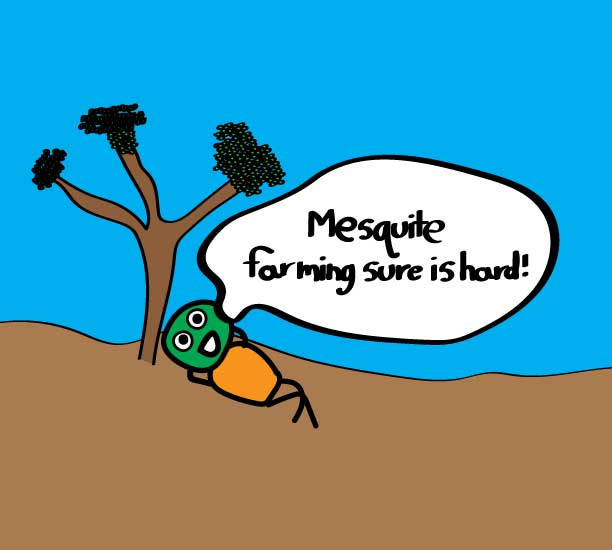
Mesquite isn’t a light-hoarder. Its leaves are feathery and small, providing shelter for other plants and animals from the long hours of scorching desert sun but letting through enough light for other plants to be grown underneath the canopy. As a bonus, mesquite belongs to that generous group of plants known as nitrogen fixers, which work with bacteria in their roots to take nitrogen from the air and fix it in the soil, enriching the earth and providing essential nutrition for other plants. The pioneers could still have grown their vegetables, but in the dappled shade and with the free fertilizer of the mesquite.
Mesquite helps prevent erosion from torrential rains by holding on to the soil with its roots. It lessens the power of the desiccating desert winds. It provides a source of firewood and material for building, basketry, crafts, fencing, and food for pollinating insects (flowers) and livestock (pods). Mesquite even has medicinal value.5 What a giving tree! It seems to embody the spirit of the United Order that the Bunkerville Saints were working so hard to establish.
Unfortunately, now as then, the mesquite is considered worthless. Its gifts are scorned. It’s deemed a nuisance, and we spend blood and treasure on a futile quest to eliminate it, failing to understand that not only is the mesquite an integral member of the landscape, but it protects the land from further degradation and abuse, in turn shielding us from the full weight of our own catastrophic errors. Like so many things that we have deemed inconvenient or worthless, the mesquite is here to help and protect us, if only we have the humility to accept its gifts.
For the Bunkerville Saints, ignorance of the landscape (not only of mesquite, but of how to work with water, a topic which we’ll undoubtedly discuss another time) cost them endless, dusty hours in the hot sun and probably some frustration and anger that spilled over into personal relationships. The wear and tear, stress and worry of annual irrigated grain cultivation in the desert probably contributed to the ultimate abandonment of their most cherished ideals. It’s easy to look at these people of the past and say, “coulda, shoulda, woulda,” but the truth is, these hard-working pioneers had limited resources with which to learn the real potential of their surroundings. Their efforts were pretty fantastic.
Ironically, the land these Saints worked so hard to transform is now best known for the Cliven Bundy range wars and the casinos lining the streets of Mesquite, Nevada. Probably not the legacy the pioneers had envisioned.
We can learn from our forebears’ mistakes. And we can learn from the elegant and beautiful traditions that people living in better harmony than we currently do built up through trial and error over generations. Not all of us need to eat mesquite. But there are “mesquites” in every landscape – plants and animals that we view with irritation—or don’t see at all—because of our ignorance or prejudice. With some learning and observation, they can become trusted partners who nudge us towards a more harmonious way of living. So much has been pulled apart in our world, but as we put pieces back together, maybe, just maybe, we will also learn to live in harmony with each other and realize those long-cherished dreams of the Bunkerville Saints.
https://cals.arizona.edu/fps/sites/cals.arizona.edu.fps/files/cotw/Mesquite.pdf
Leonard Arrington, Feramorz Fox, and Dan May. 1976. Building the City of God: Community and Cooperation Among the Mormons.
Wendell Berry. 2003. The Citizenship Papers, “The Two Minds.” Accessible at https://www.clarionreview.org/2015/02/two-minds/
Desert Harvesters. 2018. Eat Mesquite and More: A Cookbook for Sonoran Desert Foods and Living.
Gary Paul Nabhan. 1986. Gathering the Desert.